
Health innovators know that good ideas need more than inspiration to move from discovery to impact.
They need evidence, talent, data, clinical partners, manufacturing capacity, public health systems, trust, timing, and a thousand operational details that rarely make the pitch deck. Scaling a clinical breakthrough takes more than enthusiasm and a beautiful Canva roadmap.
Much of that pathway is supported by federal science.
Federal science is part of the infrastructure underneath health innovation. It supports the research that helps us understand disease, the public health systems that track threats, the data that informs decisions, the engineering science behind devices and robotics, the clinical trials that test new therapies, and the public servants who keep complex systems running.
That infrastructure is under strain.
This isn’t news to most people in health innovation. We have seen the headlines. We have heard about the cuts. Many of us have been directly affected or have colleagues, partners, grantees, or former teammates feeling the effects directly. We hear it echoed in conversations across industries, whether in formal meetings or informal spaces like Bonne Fire happy hours where people compare notes on how these changes are landing in different ways.
The harder work is moving beyond awareness to actively unpack what these changes mean for us here in Georgia.
How does it affect the research pipeline we depend on? The public health systems in our backyard? The pediatric and cancer care institutions we point to with pride? The engineering, robotics, data science, and advanced manufacturing capacity we need to build the next generation of health solutions?
Partnership for Public Service’s Cost of Cutting American Science tool helps make these connections visible. It shows how changes to federal science capacity are reaching people, programs, institutions, and communities across the country.[1]
For health innovators, the tool offers both evidence and a mirror. It helps us see the public infrastructure our work depends on.
The human side: patients and families feel the impact
One of the clearest examples is deeply human: a patient whose therapy was delayed because the system around the science could not move fast enough.
A cancer patient in Greensboro, Georgia, was preparing to receive a custom-built cell therapy through the National Institutes of Health when staffing cuts slowed the final steps needed to deliver it. His treatment, engineered from his own immune cells to recognize and attack his cancer, was already in process. According to The Washington Post, what had been a three-to-four-week timeline stretched to eight to ten weeks after specialized lab staff were cut.[2]
This is what federal science capacity can mean in real life: a patient waiting while a therapy that could help remains just out of reach.
Listen to Richard Schlueter’s experience, who experienced delays getting the cancer therapy he hoped would save his life because of firings at the NIH.
For anyone working in health innovation, this should land hard. The path from discovery to patient care depends on more than a good idea. It depends on labs, reviewers, protocols, procurement, data systems, clinical operations, and people with the expertise to move each step forward.
A second example shows how federal funding uncertainty can affect pediatric research before a trial ever reaches the children and families waiting for better options. Researchers had proposed a national clinical trial testing an mRNA vaccine approach for diffuse intrinsic pontine glioma, or DIPG, a devastating childhood brain tumor. The proposal received a strong peer-review score, and families who had lost children to DIPG had already helped raise money to move the work forward. But amid NIH funding disruptions, the trial was left unfunded.[3]
For those families, research is how they keep a promise to the children they lost, and how they fight for better options for the next family.
This is the human side of federal science capacity. When the system slows, patients wait. Families carry more of the burden. Researchers lose momentum. Companies lose clarity. Investors see more uncertainty. And Georgia loses speed in the very areas where we are trying to lead.
What this means for Georgia’s health innovation ecosystem
Federal science is woven into Metro Atlanta and Georgia, deeper than most people realize.
Atlanta has the raw ingredients of a world-class health innovation hub: CDC in our backyard, major research universities and medical institutions, nationally recognized engineering capacity, leading clinical anchors, a growing life sciences footprint, and a rapidly expanding healthtech ecosystem. Across Emory, Georgia Tech, Morehouse School of Medicine, Grady, Children’s Healthcare of Atlanta, Winship Cancer Institute, the Georgia Research Alliance, Science Square, public health agencies, startups, manufacturers, funders, community-based organizations, and clinical research teams, the region has the infrastructure to move ideas from discovery to implementation.
Federal science helps feed that infrastructure.
At Emory, NIH funding supports the biomedical research base behind discovery, clinical trials, training, translational partnerships, and the evidence health innovators build on. In 2021, Emory received about $600 million in federal funding ($526 million from NIH alone) and $894.7 million in external research funding overall.[4]
At Georgia Tech and Georgia Tech Research Institute (GTRI), federal research support helps sustain the engineering, robotics, data science, cybersecurity, devices, and manufacturing capacity that increasingly shapes the future of care. GTRI reports nearly $1 billion in sponsored research awards, and its work spans areas such as robotics and autonomy, information and data science, cybersecurity, technology for society, and projects aimed at improving the human condition.[5]
This is the kind of applied research capacity that strengthens diagnostics, assistive technologies, medical devices, robotics, AI-enabled tools, remote monitoring systems, and advanced manufacturing for health and medical technologies.
Atlanta is also actively building for the next chapter of life sciences and health innovation. Science Square, a collaborative effort between Georgia Tech, Trammell Crow Company, and High Street Residential, is planned to span 18 acres with 1.8 million square feet of lab and office space, 500 residential units, and 25,000 square feet of retail space. Its first phase includes 364,871 rentable square feet.[6]
This kind of physical investment reaches its full potential when the upstream science, workforce, and funding environment remain strong enough to feed it.
The Partnership’s tool reports that science agencies obligated $112.6 billion in project grants in fiscal 2025, a 24.1 percent decrease from fiscal 2024.[7] For Georgia’s health innovation ecosystem, that kind of disruption can move quickly from national data point to local consequence.
A delayed grant can become a delayed study.
A delayed study can become a delayed product, therapy, or intervention.
A lost trainee can become a missing researcher, founder, clinician, engineer, or implementation leader five years from now.
Georgia knows how to multiply research investment
Georgia has already shown what happens when public science, institutional capacity, and private-sector translation work together.
The Georgia Research Alliance (GRA) offers a useful example. GRA reports that $728 million in state investment since 1991 has helped attract $16 billion in research grants, venture capital, matching funds, and other dollars. That is the flywheel health innovation depends on: public investment, research capacity, institutional strength, private capital, commercialization, talent, and real-world impact.
That flywheel is visible across the region. It runs through research universities, clinical partners, public health institutions, pediatric and cancer care, startups, manufacturers, community organizations, and innovation districts.
Federal science helps create the evidence, protections, readiness, and shared infrastructure that everyone else builds on.
It helps make discovery less risky. It supports long timelines. It funds early, complex, and public-interest science.
It creates the conditions that allow private innovation to move faster and with more confidence.
It’s how the work gets done. Full stop.
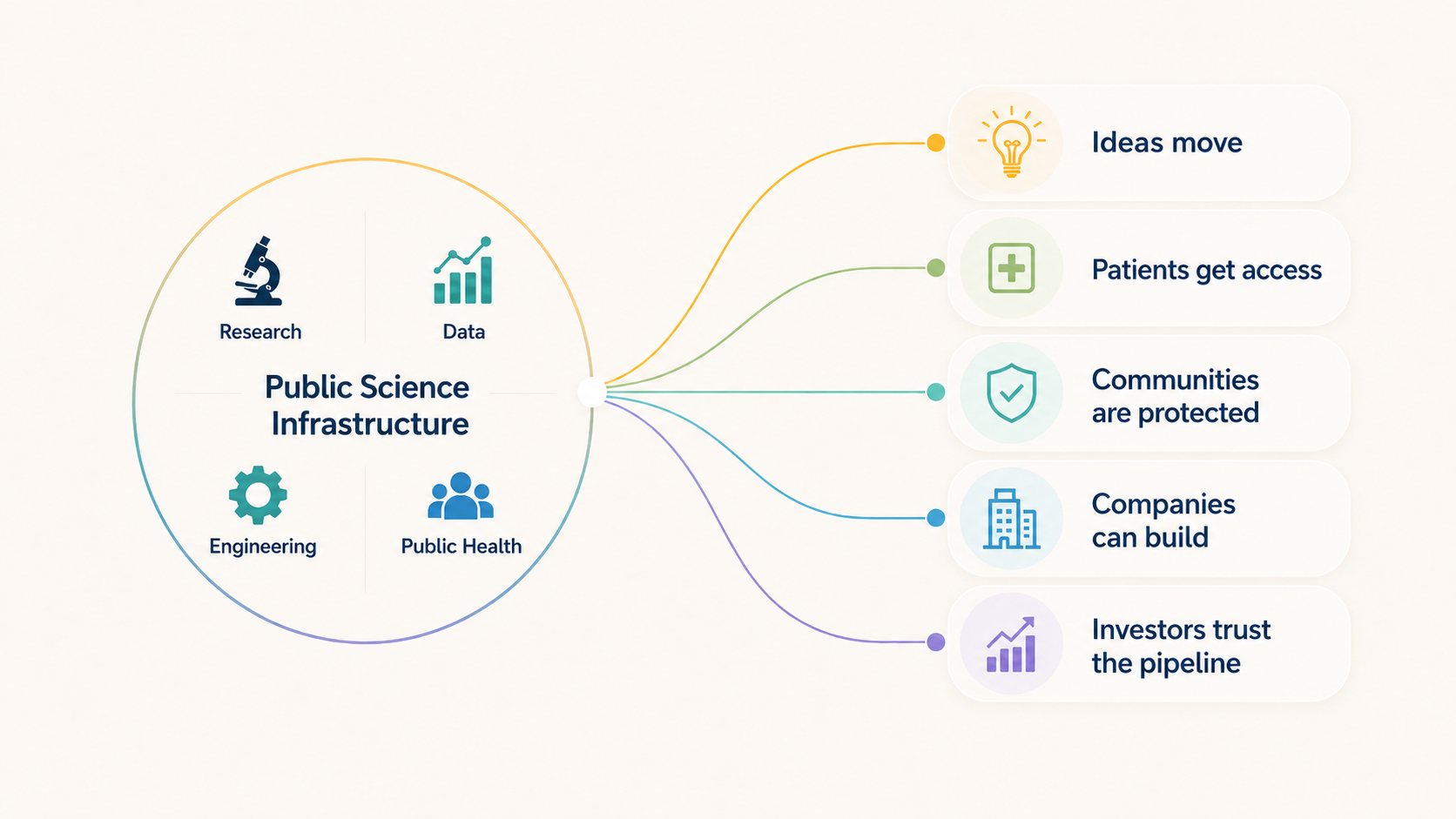
Health innovation depends on the public science infrastructure that supports discovery, safety, trust, and scale. That infrastructure affects whether ideas move, whether patients get access, whether communities are protected, whether companies can build, whether investors can trust the pipeline, and whether Georgia can compete as a serious health innovation hub.
What health innovators can do now
The first step is to understand the connections.
Explore the Partnership for Public Service’s Cost of Cutting American Science tool.
Look at the national picture. Look at the local impacts. Look at the sectors connected to your work, including scientific discovery, biomedical research, public health, food and agriculture, the environment, and public lands.[8]
Then ask a practical question: where does my work depend on federal science?
Does it depend on NIH research, NSF-supported engineering, CDC data, FDA regulatory science, public health surveillance, university labs, clinical trials, workforce training, community-based implementation, or federal grants that sustain local partners?
Most organizations will find more connections than they expect.
The second step is to talk about it.
Share this piece with your network. People outside science and health innovation need to understand what is at stake in plain language, through examples that connect to their own communities and families.
If federal science cuts have affected your work, your patients, your company, your research, your organization, or your community, share your story with the Partnership: https://federalharmstracker.org/share-your-story/
And if you want simple ways to get involved,
Visit the Partnership’s public science campaign page: https://ourpublicservice.org/public-science-serves-america
Health innovation runs on brilliant ideas, and it also runs on people, public systems, evidence, data, trust, and time.
When we understand that infrastructure, we can build with more clarity, advocate with more precision, and help ensure promising solutions have a real path to the people and communities they are meant to serve.
Sources
[1] Partnership for Public Service, Cost of Cutting American Science, https://science.federalharmstracker.org/.
[2] Carolyn Y. Johnson, “His custom cancer therapy is in an NIH freezer. He may not get it in time,” The Washington Post, June 18, 2025, updated Aug. 18, 2025, https://www.washingtonpost.com/science/2025/06/18/nih-cancer-therapy-delay-staff-cuts/. Related video: “NIH cuts delayed his cancer treatment. This is his message,” The Washington Post, Aug. 11, 2025, https://www.washingtonpost.com/video/national/nih-cuts-delayed-his-cancer-treatment-this-is-his-message/2025/08/11/e6b947bf-5e85-4941-86ba-7d93f491eae8_video.html.
[3] Carolyn Y. Johnson, “NIH pulled off a ‘near miracle.’ Scientists say there’s still a problem,” The Washington Post, Sept. 26, 2025, https://www.washingtonpost.com/science/2025/09/26/nih-funding-research-grants/.
[4] Emory News Center, "Emory receives record funding for research with $894 million in last year," Sept. 2021, https://news.emory.edu/stories/2021/09/emory_research_funding_2021/index.html
[5] Georgia Tech Research Institute, homepage and expertise areas, https://www.gtri.gatech.edu/.
[6] Georgia Tech Real Estate Office, “Science Square,” https://realestate.gatech.edu/science-square.
[7] Partnership for Public Service, “The Unraveling of Public Science,” https://federalharmstracker.org/the-unraveling-of-public-science/.
[8] Partnership for Public Service, Cost of Cutting American Science, https://science.federalharmstracker.org/.
[9] Partnership for Public Service, “The Unraveling of Public Science,” Get Involved form, https://federalharmstracker.org/the-unraveling-of-public-science/#get-involved.
Disclosure: This piece was supported by the Partnership for Public Service. The analysis and views expressed are the author’s own.
